
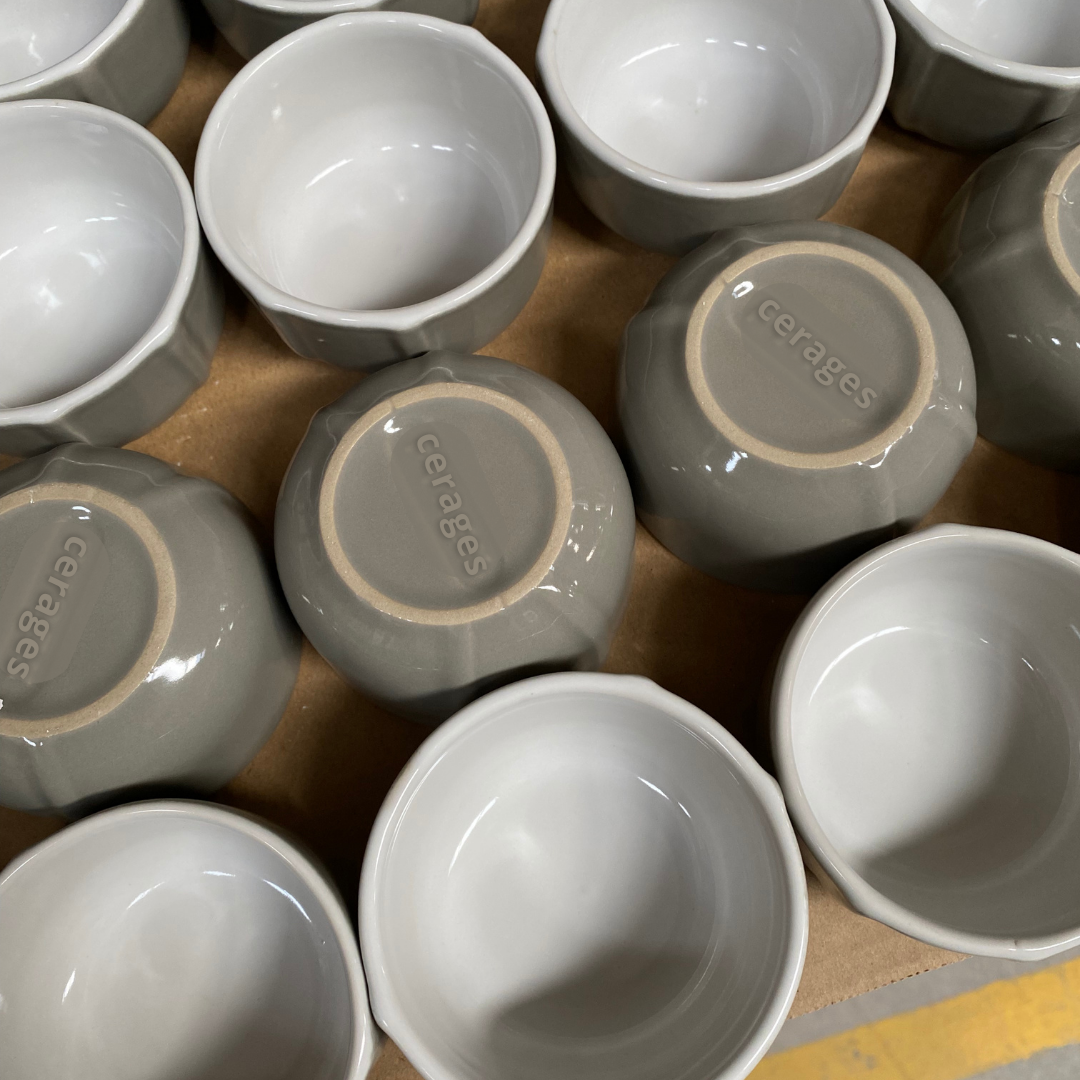

A Sourcing Director’s Guide to Quality Assurance in Stoneware Bakeware
When procuring private label stoneware ovenware for international retail networks or commercial kitchen distribution, brand managers encounter critical technical variables that dictate both product success and liability exposure. Below is an expert breakdown of the engineering metrics that distinguish professional-grade stoneware from substandard alternatives.
1. Clay Body Composition & Mineralogy
The core performance of any piece of bakeware originates in its raw material mix. Premium Portuguese stoneware relies on a carefully balanced formulation of ball clays, kaolin, quartz, and feldspar sourced from local geological deposits in central Portugal. The presence of high-grade kaolinite ensures structural integrity during forming, while fluxing agents like feldspar promote glass-phase vitrification at high temperatures. This mineral blend ensures that during firing at 1250°C, open pores seal completely, preventing water absorption that leads to bacterial growth or internal steam expansion during baking.
2. Thermal Shock Mechanics (Understanding ΔT)
Thermal shock occurs when rapid temperature differentials induce differential thermal expansion across a ceramic object's wall thickness. If the outer surface expands or contracts significantly faster than the core matrix, tensile stress exceeds the material's mechanical strength, leading to sudden fracture. Cerages engineers stoneware ovenware with a low coefficient of thermal expansion (CTE), allowing the finished baking dish to endure sudden temperature shocks exceeding ΔT 220°C. This allows smooth transitions from deep freezer storage (-20°C) straight to convection heating (+200°C) or microwave cycles.
3. Glaze Physics & Cutlery Resistance
Aesthetically striking bakeware must also resist harsh real-world conditions. Substandard glazes frequently exhibit knife marks—grey metallic deposits caused by cutlery scratching soft glaze surfaces. Cerages utilizes raw materials rich in silica and alumina to yield high Mohs hardness ratings (7.0+). Furthermore, our lab conducts rigorous dishwasher testing using aggressive commercial detergents (up to 1,000 continuous cycles) to guarantee zero glaze dulling, fading, acid erosion, or alkali etching.
4. International Regulatory Compliance & Food Safety Standards
Food contact compliance is mandatory for global distribution. All stoneware ovenware manufactured by Cerages complies with European Regulation (EC) No. 1935/2004, California Proposition 65, US FDA guidelines, and German LFGB standards. Our lead-free and cadmium-free glazes are systematically tested via atomic absorption spectroscopy (AAS) and ICP-OES to confirm non-detectable heavy metal leaching under acidic testing conditions (4% acetic acid at 22°C for 24 hours).