Direct factory production lines optimized for high-density HoReCa usage, thermal shock resistance, and compliance with South Korea's MFDS food safety regulations.

An authoritative technical analysis for commercial procurement officers, hotel supply chain executives, and retail brand directors importing stoneware into Korea.
South Korea’s hospitality and dining market is experiencing a profound transformation. As Seoul, Busan, and Incheon continue to expand as global culinary centers, commercial dining establishments are ditching standard melamine plasticware in favor of heavy-duty, tactile stoneware. Modern Korean cuisine ("New Hansik") demands plating solutions that honor traditional earth-toned ceramics (like classic Buncheong and Joseon white porcelain aesthetics) while withstanding the intense operational friction of high-volume automated dishwashers and high-temperature salamanders.
For B2B buyers and commercial distributors serving the Korean Peninsula, selecting a factory partner is no longer just about per-unit cost. It requires a manufacturing backbone capable of delivering high thermal density, zero-porosity vitrified bodies, zero heavy-metal leaching, and strict compliance with Korea's Ministry of Food and Drug Safety (MFDS) standards.
Cerages, operating out of Mortágua, central Portugal, since 1993, provides Korean importers with a unique competitive edge: authentic European stoneware craftsmanship combined with industrial-scale OEM output. European ceramics enjoy immense prestige across South Korea's upscale department stores (e.g., Shinsegae, Hyundai, Lotte) and five-star luxury hotel chains.
Unlike fragile earthenware, our high-fired stoneware is subjected to temperatures exceeding 1250°C. This vitrification process welds clay and glaze into a monolithic material with less than 0.5% water absorption, rendering it immune to grease retention, bacterial growth, and micro-cracking during deep thermal shifts.
Data engineered for hotel supply chains, purchasing directors, and B2B distributors evaluating long-term replacement cycles in South Korea.
| Performance Metric | Cerages Vitrified Stoneware | Standard Commercial Earthenware | Commercial Melamine Plastic |
|---|---|---|---|
| Firing Temperature | 1250°C – 1280°C (Fully Vitrified) | 1000°C – 1100°C (Semi-Porous) | Synthetic Resin Molding |
| Water Absorption Rate | < 0.5% (Impervious to moisture/odor) | 3.0% – 7.0% (Risk of glaze crazing) | Non-porous (Prone to staining) |
| Thermal Shock Resistance | Up to ΔT 220°C (Freezer-to-Oven Safe) | Up to ΔT 120°C (Risk of cracking) | Low (< 90°C, Cannot oven bake) |
| Dishwasher Lifecycle Test | 2,000+ Commercial High-Temp Cycles | 300–500 Cycles (Glaze fading) | Fades, scratches & warps over time |
| Heavy Metal Leaching (Pb/Cd) | 0.0 mg/L (Exceeds MFDS & FDA Limits) | Varies (Requires frequent testing) | Formaldehyde/Melamine risk at high heat |
Information Gain Insight for South Korean Importers: Under South Korea's Food Sanitation Act, imported food contact ceramics undergo stringent testing at customs for Lead (Pb) and Cadmium (Cd) dissolution. Cerages utilizes in-house laboratory-tested, 100% lead-free reactive and solid glazes. Sourcing fully vitrified Portuguese stoneware minimizes port clearance rejection risks to zero while securing an extended operational lifespan for hospitality clients.
How our ceramic stoneware profiles address operational challenges in key commercial environments across Seoul, Busan, and major urban districts.
Operational Need: Resistance to oil penetration, intense heat radiation, and heavy metal cutlery friction.
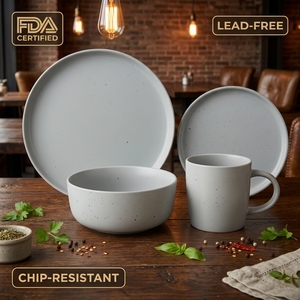
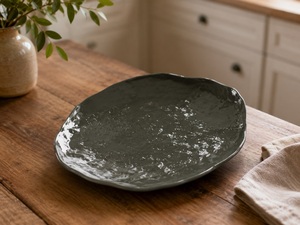
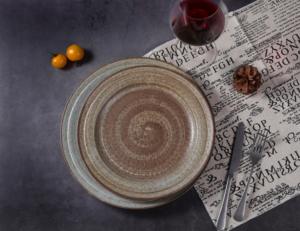
Modern K-BBQ establishments in Gangnam and Hongdae present banchan (side dishes) alongside sizzling hot meats. Standard plates suffer from grease absorption and knife marks. Our matte cement grey stoneware and reactive textured plates feature scratch-resistant glaze formulations that prevent cutlery scoring while offering an organic, slate-like canvas that elevates meat presentation.
Operational Need: High stackability, chip-resistant reinforced edges, and light weight for service staff efficiency.
5-Star properties require dinnerware that moves seamlessly from warming cabinets to banquet tables. Cerages’ custom stoneware features precise rim geometry designed to nest cleanly without sliding. Edge-reinforcement technology cuts chipping rates by over 40% during fast-paced commercial dishwashing cycles.
Operational Need: Photogenic "Instagrammable" glaze variations and unique tactile textures.
South Korea’s cafe culture thrives on social media aesthetics. Our 1,300+ glaze library—featuring reactive glazes that produce subtle, handcrafted color fluctuations—transforms simple baked goods and coffees into visually striking culinary moments. Each plate behaves like a unique piece of studio pottery while maintaining industrial consistency.
Understand what drives purchasing managers and lifestyle brand curators in South Korea today.
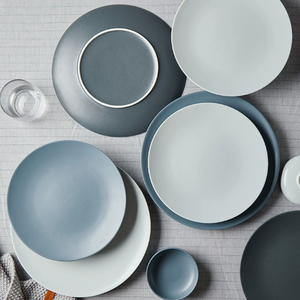
Interior design in Korean hospitality is shifting toward warm wood tones, exposed stone, and traditional Hanok architecture motifs. Tableware buyers are aggressively phasing out bright, artificial high-gloss whites in favor of low-gloss matte cement grey, sand beige, moss green, and warm clay reactive glazes that complement natural interior materials.
South Korean corporate policy and consumer sentiment heavily favor eco-friendly sustainability. Major franchise restaurant chains are replacing synthetic melamine tableware—which degrades under heat and leaches micro-plastics—with 100% natural, recyclable stoneware fired using energy-efficient kilns and recycled clay bodies.
Korean lifestyle retailers (e.g., JaJu, Modern House) and boutique restaurant groups demand complete brand ownership. Buyers seek OEM partners who can engrave custom backstamps, logos, and origin marks onto the base of each piece before the final firing, transforming generic dinnerware into proprietary brand assets.
Combining over three decades of ceramic engineering with integrated R&D under one roof in Mortágua, Portugal.
From initial 3D design files or physical samples provided by Korean clients, our in-house master sculptors craft production moulds directly on site. Shrinkage rates (typically 10-14% during high-temperature firing) are calculated mathematically to guarantee that final fired dimensions match technical specifications to within millimeter tolerances.
Repeat orders are the lifeblood of restaurant chains and retail assortments. Our ISO 9001:2015 certified production tracking locks in the exact clay slurry density, glaze viscosity, dipping duration, and kiln thermal curves. Order #10 delivers the exact same weight, shade, and edge geometry as Order #1.
Whether matching a brand's corporate Pantone code, replicating a traditional Korean celadon hue, or creating custom dual-tone reactive glazes, our laboratory chemists formulate glazes from scratch. All glazes are cadmium-free, lead-free, and formulated to resist detergent etching in commercial dishwashers.
We possess deep experience handling containerized freight (20ft / 40ft HQ) departing from Leixões or Lisbon ports directly to Busan or Incheon. Every pallet is wrapped, corner-reinforced, and drop-tested to withstand oceanic sea-freight stress, ensuring zero breakage upon arrival.
Clear answers regarding OEM customization, food safety compliance, minimum orders, and shipping to Korean ports.
Yes. Cerages operates almost exclusively on a private label, OEM, and ODM basis. The backstamp on the underside of each piece, custom shapes, glaze colors, and retail packaging are fully customized according to your specifications. Finished goods carry your brand identity exclusively.
All our clay bodies and glazes are formulated using 100% natural, non-toxic minerals free from lead and cadmium. Before shipment, we provide complete laboratory test declarations certifying compliance with international food contact standards (EU Directive 84/500/EEC, FDA, and South Korea’s Food Sanitation Act guidelines).
Earthenware is fired at lower temperatures, leaving the clay body porous and fragile. Cerages stoneware is fired at over 1250°C until the clay body fully vitrifies. This results in a dense, non-porous ceramic (<0.5% water absorption) that resists thermal shock, edge chipping, scratching, and stain absorption—making it vastly superior for commercial restaurant usage.
Absolutely. Our in-house chemical laboratory maintains over 1,300 developed glaze formulations in matte, high-gloss, solid, and reactive finishes. We can match physical color swatches or Pantone references provided by your design team and produce pre-production samples for your approval.
MOQs depend on the shape complexity and glaze specification, typically starting at 1,000 to 3,000 units per item for custom production. Sample creation and glaze matching usually take 2 to 3 weeks, while mass production requires 6 to 8 weeks prior to sea freight shipment from Portugal to Busan or Incheon ports.
Yes. Our vitrified stoneware bodies are engineered to withstand thermal shocks up to ΔT 220°C. They are 100% safe for conventional baking ovens, commercial microwave heating, industrial dishwashers, and freezer storage without risk of cracking or glaze deterioration.
Consult directly with our ceramic technicians in Mortágua, Portugal. Tell us your target shapes, glaze preferences, and quantity requirements for the South Korean market—we will engineer the precise technical solution.
Send an Inquiry