Direct factory-engineered stoneware solutions tailored for Italian hospitality procurement, commercial distributors, and private-label retail brands.
An analytical overview of decarbonization trends, regulatory frameworks (CAM & EU 1935/2004), and supply chain economics for Italian commercial stoneware importers.
Italy’s ceramic sector—centered around districts like Sassuolo and regional table-art hubs—demands exceptional design alignment alongside strict structural integrity. As Italian commercial buyers in Milan, Bologna, Rome, and Naples navigate shifting EU ESG directives, the market is aggressively pivoting from low-temperature earthenware to ultra-dense vitrified stoneware.
Importing sustainable stoneware into Italy requires navigating complex statutory standards including Italian Ministerial Decree 21/03/1973 for food contact, REACH regulations, and the rigorous Criteri Ambientali Minimi (CAM) mandated for public hospitality and municipal procurement tenders.
Modern Italian buyers demand verified supply chain transparency. Our manufacturing framework utilizes fully integrated closed-loop clay recovery systems where 100% of unfired body scrap is slurred back into production, eliminating raw material wastage.
By optimizing kiln load densities with engineered cordierite furniture and leveraging high-velocity heat recovery systems, energy expenditure per unit produced is minimized. This provides Italian brand partners with a distinct carbon-footprint advantage aligned with the European Green Deal.
Comparing technical body properties for high-frequency hospitality and retail distribution in Italy:
| Physical Metric | High-Density Stoneware (Our Standard) | Commercial Earthenware | Standard Porcelain |
|---|---|---|---|
| Firing Temperature Range | 1250°C – 1280°C (High Vitrification) | 1000°C – 1150°C (Low Vitrification) | 1300°C – 1400°C |
| Water Absorption Capacity | < 0.5% (Impermeable Body) | 5.0% – 12.0% (Porous Body) | < 0.2% |
| Thermal Shock Resistance (ΔT) | Up to 200°C (Oven-to-Table Safe) | Max 110°C (Prone to Crazing) | Up to 180°C |
| Edge Chipping Resistance | High (Flexural Strength > 45 MPa) | Low (Fractures Under Impact) | Very High |
| Glaze Hardness (Mohs Scale) | 6.5 – 7.0 (Scratch Resistant) | 4.0 – 5.0 (Scuffs Easily) | 7.0 |
| EU Food Contact Compliance | Lead/Cadmium < Detection Limit | Requires High Metal Testing | Lead/Cadmium Free |
Operating from Mortágua, Portugal, Cerages brings over 30 years of engineering excellence to B2B private label manufacturing, OEM developments, and custom stoneware supply chains across global markets including Italy.
Our in-house mould shop, glaze laboratory, shaping facilities, and high-temperature kilns share a unified footprint in Mortágua. Technical revisions to backstamps, wall thicknesses, or reactive formulations remain under rigorous internal engineering control, reducing sample cycle lead times by up to 40%.
Our chemical laboratory maintains a proprietary archive of over 1,300 glazes—offering reactive finishes, silk-matt cements, high-gloss vitrified surfaces, and tactile mineral textures. All formulations are completely lead- and cadmium-free, verified for intense commercial washing cycles.
We operate 100% on a private label and OEM basis. Every batch produced carries the buyer's custom backstamp, specific structural dimensions, and bespoke packaging configuration. Quality management is strictly audited under ISO 9001:2015 specifications.
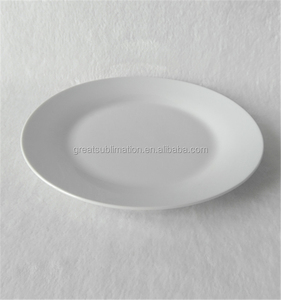
Engineered ceramic solutions optimized for Italy's regional culinary landscapes, design ecosystems, and commercial procurement sectors.
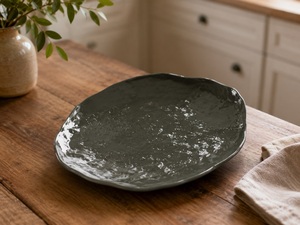
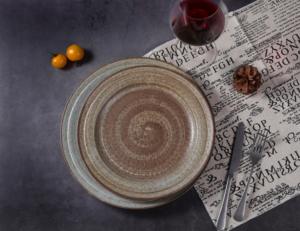
Rustic, heavy-gauge reactive glaze dinnerware designed for thermal heat retention in rural culinary resorts, withstanding heavy handling and rustic wood-fired kitchen environments.
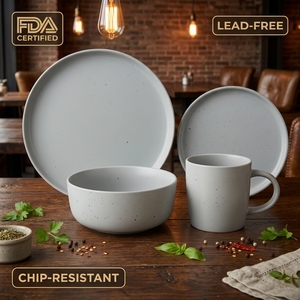
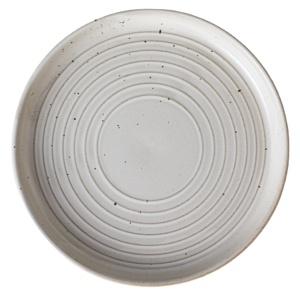
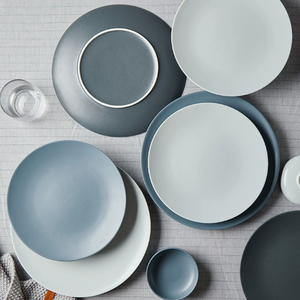
Minimalist matte cement grey plates and 3D textured chargers tailored for high-end boutique home concept stores, aligning with contemporary Scandinavian-Italian fusion interior aesthetics.
Salt-air resistant, high-density non-porous serving platters with reinforced rims to eliminate edge chipping in oceanfront fine dining and commercial hospitality dishwashers.
Precision-moulded stackable stoneware sets engineered for compact palletized transport, fast thermal recovery, and high-frequency automated washing cycles in Italian banquet hubs.
From initial 3D design files to DDP delivery in Italian distribution hubs, our end-to-end operational roadmap guarantees zero quality variance.
Italian buyers submit technical drawings, 3D render files, or physical reference samples. Our engineers analyze wall taper, shrinkage coefficient during 1280°C firing, stacking stability, and volumetric capacity.
Master plaster moulds are milled in our Mortágua mould shop. Glaze technicians match target Pantone hues or physical mineral swatches, creating physical approval prototypes within short sampling turnarounds.
Formed clay bodies undergo monitored drying and single or double firing schedules. Backstamps are permanently fused under the base glaze to ensure full compliance with EU traceability norms.
Batch sampling undergoes water absorption testing (<0.5%), thermal shock cycling (200°C to cold water), dishwashing abrasion resistance, and strict dimensional tolerance checks.
Products are packed into customized drop-test approved retail packaging, master cartons with Italian EAN/UPC barcoding, and heavy-duty EUR-pallets configured for smooth logistics.
Direct dispatch from central Portugal to major Italian freight corridors (Milan, Verona, Bologna, Naples) via seamless intra-EU road transport, eliminating external customs tariffs and complex import delays.
Key technical and commercial inquiries regarding custom stoneware imports, EU regulatory compliance, and logistics to Italy.
Yes, absolutely. Cerages operates strictly as an OEM and private label manufacturer. The customer’s brand identity, custom logo, backstamp, customized glaze, and specific retail box design are integrated directly into the production cycle. Finished products bear no trace of third-party supplier branding.
Stoneware fired at high temperature (1280°C) vitrifies into a dense, non-porous body with a water absorption rate under 0.5%. Unlike porous earthenware (which absorbs moisture, crazes, chips easily, and breaks under thermal shock), high-vitrification stoneware offers exceptional durability, remains freezer-to-oven safe, and withstands harsh commercial Italian dishwashers without glaze deterioration.
All our ceramic bodies and in-house glazes comply fully with EU Regulation (EC) No 1935/2004, Directive 84/500/EEC, and Italian Ministerial Decree 21/03/1973. Laboratory testing confirms lead and cadmium migration levels are well below statutory detection limits, and project-specific declarations of compliance (DoC) are issued with every shipment.
Because production is located in Portugal, shipments to Italy move efficiently via overland intra-EU trucking corridors. Freight bound for Northern logistics hubs (Milan, Verona, Turin) typically takes 3 to 5 transit days post-production, while Southern destinations (Rome, Naples, Bari, Sicily) take 5 to 7 days. There are no customs clearance delays or extra import tariffs within the European Single Market.
Yes. Our dedicated glaze development laboratory can match specific Pantone references, mineral standards, or physical ceramic swatches provided by your team. With over 1,300 documented glazes in our archive, we offer precise replication across both solid and reactive finishes.
MOQs are calculated per shape and glaze combination to optimize kiln loading efficiency. Typically, baseline production runs start at 500 to 1,000 units per item for specialized HoReCa or retail projects, with volume pricing advantages applied to full-container shipments.
