Precision-engineered stoneware baking dishes, oven-to-table roasters, and reactive glazed dinnerware manufactured to international ISO 9001:2015 and food-contact compliance standards.
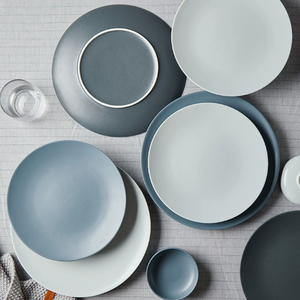
Understanding microstructural density, vitrification kinetics, and mechanical performance metrics for professional kitchenware procurement.
| Material Classification | Firing Temperature Range | Water Absorption (%) | Thermal Shock Resistance (ΔT) | Mechanical Edge Strength | Dishwasher & Oven Safety |
|---|---|---|---|---|---|
| High-Fired Stoneware (Cerages Spec) | 1220°C – 1280°C | < 0.5% (Vitrified) | Up to 220°C Thermal Delta | Superior (High Impact Res.) | Oven/Microwave/Freezer Safe |
| Commercial Earthenware | 1000°C – 1150°C | 5.0% – 10.0% (Porous) | Poor (Prone to Crazing) | Low (Chipping Risk) | Handwash Preferred / Non-Oven |
| Hard Porcelain | 1350°C – 1400°C | < 0.1% | Moderate (Rigid Lattice) | High Hardness / Brittle Edge | Commercial Dishwasher Safe |
| Borosilicate Glassware | N/A (Melt Formed) | 0.0% | High Thermal Shock | Moderate Edge Stress | Limited Broiler Tolerance |
Stoneware manufactured at our Mortágua facility achieves a completely fused crystalline clay body during high-temperature firing. The combination of selected ball clay, kaolin, and feldspathic fluxes yields a mullite matrix that minimizes thermal expansion differentials, drastically reducing micro-fracturing when transitioning directly from a -20°C deep freeze environment into a +220°C commercial convection oven.
From initial 3D shape prototyping in Mortágua, Portugal, to scalable batch production, Cerages delivers end-to-end OEM and private label stoneware engineering.
Our specialized glaze laboratory has engineered over 1,300 proprietary formulations, encompassing matte, semi-matt, glossy, and reactive glazes. Each glaze is rigorously tested for heavy-metal leachability (Lead/Cadmium compliance under EU Directive 84/500/EEC and FDA CPG 7117.06).
Operation within an integrated ISO 9001:2015 quality management ecosystem guarantees strict batch-to-batch color repeatability, dimensional tolerances within ±1.5%, and standardized density checks across millions of production units.
100% focused on private label output. We integrate your brand mark directly into plaster molds or apply high-temperature underglaze stamps, ensuring your trademark remains crisp, indelible, and permanently fused onto every single base.
Key market shifts driving global B2B buyers toward European ceramic sourcing, eco-conscious kilns, and multi-functional kitchenware ergonomics.
Global retail and hospitality buyers are recalibrating supply chains to offset carbon tariffs and unpredictable ocean freight volatile spikes. Sourcing stoneware manufactured in Mortágua, Portugal provides North American and European importers with shortened lead times, zero EU import tariff penalties, and lower carbon footprint credentials under strict ESG frameworks.
Modern consumers and commercial restaurant operators reject single-use cooking vessels. Procurement data shows a 42% surge in demand for stoneware bakeware designed with sculptural handles, architectural nesting rims, and artisanal reactive glazes that transition seamlessly from a 250°C oven directly onto luxury dining tables.
Historical reactive glazes suffered from cutlery scratching and surface pitting. Next-generation formulation trends focus on high-zirconia matte and satin glazes. These deliver organic, one-of-a-kind color variance while achieving Mohs Hardness values exceeding 6.5, eliminating metal marking in high-turnover hospitality environments.
A rigorous 5-stage manufacturing methodology executed under one roof to guarantee structural integrity and zero structural micro-flaws.
Refined Portuguese clay body blends containing optimized ratios of kaolin and silica are blunged and filter-pressed to achieve ideal plasticity and thermal shock resistance parameters.
In-house CAD/CAM mold shop creates Master Plaster Molds. Jiggering, RAM pressing, or pressure casting shapes pieces while accurately compensating for 11–13% volumetric shrinkage.
Computerized glaze dipping, spraying, or hand-brushed technique applies non-toxic mineral oxide glazes. Backstamps and logo branding are permanently applied underglaze.
Slow-soak firing profiles vitrify the ceramic mass into dense stoneware. Pyrometric atmosphere control secures exact glaze reactivity, zero porosity, and max mechanical strength.
Everything you need to know about custom OEM development, minimum order quantities, compliance certifications, and freight handling.
Yes. We operate exclusively as a B2B OEM/ODM contract manufacturer. All shapes, specialized reactive glazes, customized retail packaging, and base backstamps are created to your exact brand specifications. Your finished shipments carry your identity, protected by strict non-disclosure agreements (NDAs).
Stoneware is fired at significantly higher temperatures (1220°C–1280°C) until the clay body reaches vitrification, resulting in a dense, non-porous structure with water absorption under 0.5%. Earthenware is fired at lower temperatures, remaining porous (>5% absorption) and prone to chipping, thermal cracking, and moisture absorption during dishwasher cycles.
All our body formulations and glazes comply strictly with European Regulation (EC) No 1935/2004, US FDA CPG 7117.06/07, California Proposition 65, and German LFGB standard testing. Formal heavy metal migration declarations and batch test reports are issued prior to shipment.
Yes. Our in-house ceramic chemical laboratory features over 1,300 benchmarked glazes, but we regularly formulate custom reactive or solid glaze matches based on physical color chips, Pantone codes, or competitor samples, locking the recipe into your dedicated master production catalog.
Initial 3D CAD modeling and plaster sampling take approximately 2 to 3 weeks. Upon prototype approval, full-scale mass production lead times typically range between 6 and 8 weeks depending on glaze complexity, order volume, and packaging configurations.