The Engineering Science of Speckled Reactive Glazes in Modern Ceramic Sourcing
An authoritative technical analysis of chemical mineral crystallization, firing kinetics, thermal shock mitigation, and supply chain strategies for enterprise ceramic buyers.
1. The Chemical Chemistry & Material Physics of Speckled Glazes
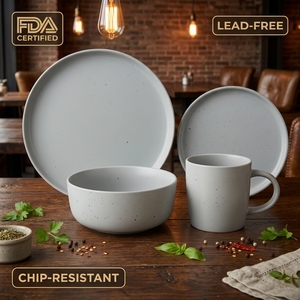
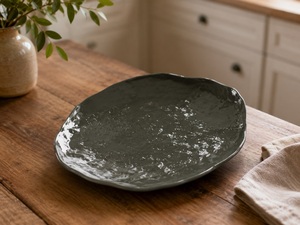
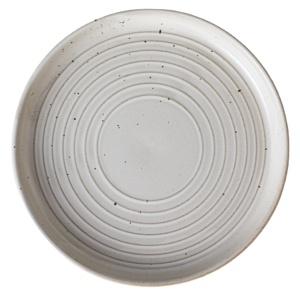
Speckled glaze stoneware represents a sophisticated intersection between mineral pyrochemical reaction and mass production reliability. Unlike standard uniform solid glazes—which rely on completely homogenous oxide solutions—speckled glazes are formulated by introducing insoluble, coarser mineral specks into a balanced liquid flux matrix. During the high-temperature firing cycle (typically between Orton Pyrometric Cone 6 to Cone 10, or 1200°C to 1300°C), these mineral particulate inclusions melt at differential temperatures, creating localized phase transformations and controlled chemical migration across the silicate surface.
The primary mineral additives utilized in our proprietary speckled glaze formulations include granular ilmenite ($FeTiO_3$), rutile ($TiO_2$), manganese dioxide ($MnO_2$), iron chromite, and synthetic cobalt-aluminate crystals. As the ceramic clay body vitrifies, these mineral particulates expand and bleed into the surrounding molten glass matrix, yielding distinctive visual depth, variegated tactile texture, and organic mottling that mimics artisan hand-thrown pottery while maintaining precise physical dimensions required for commercial stackability.
“Information Gain Insight: True commercial quality in speckled glaze stoneware is defined by controlled phase crystallization. Our laboratory formulates glazes where the particulate dispersion coefficient guarantees visual uniqueness per piece without introducing microscopic pinholes or compromising mechanical surface tension.”
Achieving structural integrity in speckled glaze ceramics requires rigorous matching of the Coefficient of Thermal Expansion (CTE) between the underlying stoneware clay body and the molten glaze layer. A mismatch in CTE leads to critical structural defects such as crazing (micro-cracking under tensile stress) or shivering (flaking of glaze under compressive stress). Through automated batching and refined ball-milling of raw clays—combining ball clay, kaolin, feldspar, and quartz silica—our technical team maintains a CTE range of $5.5 \times 10^{-6} /^\circ\text{C}$ to $6.2 \times 10^{-6} /^\circ\text{C}$, guaranteeing complete glaze-body harmony and superior mechanical impact resistance.
2. Comparative Technical Matrix: Stoneware vs. Porcelain vs. Earthenware
For B2B procurement managers, hospitality supply chains, and private label brand developers, selecting the correct ceramic substrate is a fundamental capital decision. The matrix below outlines the key mechanical, thermal, and aesthetic performance metrics across the primary commercial ceramic classifications:
| Performance Parameter | Cerages Speckled Stoneware | Commercial Porcelain | Standard Earthenware |
|---|---|---|---|
| Firing Temperature Range | 1220°C – 1280°C (Cone 7–9) | 1300°C – 1400°C (Cone 10–12) | 1000°C – 1150°C (Cone 06–04) |
| Water Absorption Rate (%) | < 0.2% (Fully Vitrified) | < 0.1% (Non-Porous) | 3.0% – 8.0% (Porous Body) |
| Thermal Shock Tolerance | High ($\Delta T \ge 180^\circ\text{C}$) | Moderate ($\Delta T \approx 140^\circ\text{C}$) | Low ($\Delta T \le 100^\circ\text{C}$) |
| Mechanical Edge Chip Resistance | Exceptional (High Elastic Modulus) | High (Brittle Failure Profile) | Low (Prone to Chipping) |
| Glaze Aesthetic Capabilities | Infinite (Reactive, Speckled, Matt) | Limited (Uniform Smooth Surfaces) | Moderate (Low-Temp Colors) |
| Commercial Dishwasher Cycle Life | 2,500+ Industrial Cycles | 3,000+ Industrial Cycles | < 300 Cycles (Glaze Crazing) |
3. Global B2B Ceramic Procurement & Sourcing Trends (2025–2030)
The global tabletop and housewares procurement landscape is undergoing a structural transition driven by changing consumer aesthetics, stringent global food-contact safety compliance, and ESG-mandated sustainability goals. Sourcing executives and hospitality group buyers must navigate four dominant mega-trends over the coming decade:
A. Demand for Artisanal Warmth at Industrial Scale
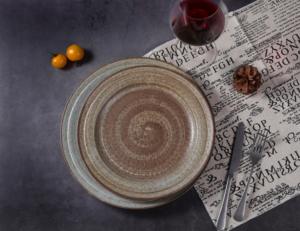
Modern consumers and restaurant guests are rejecting sterile, mass-produced white porcelain in favor of organic, tactile dining experiences. Speckled glazes, textured cement-look surfaces, and reactive earth tones satisfy this desire for authenticity. However, commercial food service operations require strict dimensional consistency for dishwashing racks and automated kitchen stacking. The challenge for manufacturers is producing tableware that appears individually handcrafted while retaining tight dimensional tolerances ($\pm 1.5\text{ mm}$).
B. Zero-Tolerance Heavy Metal Migration Standards
International regulatory oversight regarding heavy metal leaching from ceramic glazes is intensifying. Compliance with US FDA CPG Sec. 545.400/450, California Proposition 65, and European Regulation (EC) No 1935/2004 requires absolute elimination of lead ($Pb$) and cadmium ($Cd$) frits. Modern speckled glazes utilize specialized calcium-alumino-silicate and barium-free boron fluxes to achieve deep visual reaction without toxic metal release, verified through ICP-MS (Inductively Coupled Plasma Mass Spectrometry) testing protocols.
C. Energy-Efficient Firing & Circular Clay Reclamation
With rising industrial energy costs and corporate carbon-neutral commitments, European and global buyers prioritize factories utilizing heat-recovery tunnel kilns and closed-loop clay body systems. By channeling waste heat from kiln cooling zones back into spray dryers and greenware pre-heating chambers, modern manufacturing units reduce natural gas consumption by up to 28% per metric ton of fired ceramic.
4. OEM/ODM Enterprise Capabilities: From Concept to Palletized Delivery
Operating from our integrated manufacturing infrastructure in Mortágua, Portugal, Cerages provides a seamless end-to-end OEM and private label manufacturing workflow designed specifically to serve multi-national retail chains, hotel procurement groups, and boutique design houses.
In-House Glaze R&D Lab
Our library holds over 1,300 documented glaze formulations. Our ceramic chemists formulate custom speckled, reactive, glossy, or ultra-matt glaze effects based on physical Pantone standards or client-supplied inspiration swatches.
Precision Mould Engineering
Utilizing 3D CAD/CAM modeling and CNC master-block carving, we design plaster and pressure-casting moulds that compensate precisely for volumetric clay shrinkage, ensuring strict rim circularity and stackability.
Custom Backstamping
Every piece produced under private label contracts can be permanently backstamped with buyer logos, SKU codes, food-safety icons, and country-of-origin marks via debossed mould carving or high-fire underglaze decals.