High-temperature vitrified ceramic plates designed for heavy-duty commercial HORECA hospitality and global retail brands.
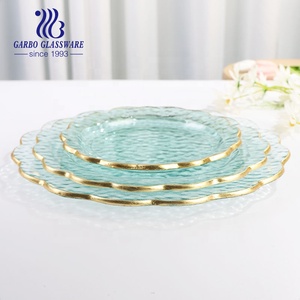
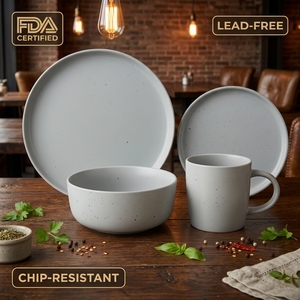
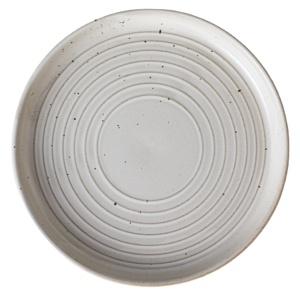
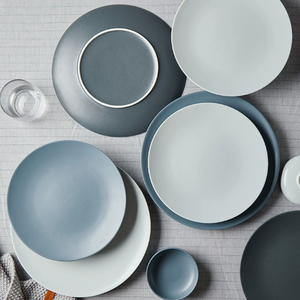
Combining three decades of Portuguese ceramic mastery with modern automation, technical glaze chemistry, and rigorous international compliance.
Our proprietary chemical glaze database hosts over 1,300 developed glazes, ranging from deep reactive matrix finishes to scratch-resistant ultra-matte surface treatments. Custom color matching is guaranteed via spectrophotometric testing (CIELAB ΔE < 0.5).
Fired at temperatures exceeding 1180°C to 1250°C, our raw clay bodies complete full vitrification. Integrated closed-loop heat recovery systems drastically diminish energy consumption while recycling 100% of unfired clay waste back into production.
From 3D CAD modeling and rapid plaster prototyping to permanent laser-engraved bottom backstamps. We offer end-to-end contract manufacturing, delivering turnkey retail-ready packaging and strict ISTA-3A drop-test compliance for global e-commerce order fulfillment.
The global commercial ceramic tableware market is undergoing a structural transition. Driven by changing hospitality dynamics, online direct-to-consumer lifestyle brands, and escalating international food safety compliance standardizations (such as EU Regulation No 1935/2004, FDA CPG 7117.06/07, and California Proposition 65), professional procurement teams are systematically shifting their sourcing allocations away from traditional porous earthenware toward high-fired vitrified stoneware plates.
Unlike earthenware, which is fired at lower thermal thresholds (typically 950°C–1050°C) leaving an open pore structure susceptible to water absorption above 5%, high-grade stoneware undergoes complete physical and chemical vitrification at 1180°C to 1280°C. During this phase, quartz and feldspar elements fuse into a dense crystalline matrix.
For commercial hotel and restaurant (HORECA) buyers, this structural density yields a water absorption rate under < 0.5%. The operational advantages are decisive:
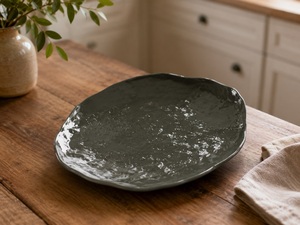
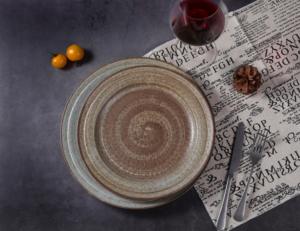
In modern tableware retail and high-end gastronomy, visual differentiation relies heavily on unique surface finishes. The legacy market relied on uniform, single-tone monochrome glazes. Today, the leading market trend is dominated by reactive glazes—a complex chemical process where metal oxides (copper, iron, cobalt, titanium) interact dynamically within the kiln fire atmosphere.
Achieving batch-to-batch consistency in reactive glaze manufacturing requires rigorous lab protocol. As an OEM supplier, our technical laboratory controls kiln atmosphere oxidation, ramp-up curves, and cooling phase cycles to ensure that while every plate displays handcrafted micro-variations, color parameters stay within strict tolerance limits (CIELAB ΔE standards).
| Performance Parameter | High-Fired Stoneware (OEM Standard) | Hard Porcelain | Commercial Earthenware |
|---|---|---|---|
| Firing Temperature Range | 1180°C – 1280°C | 1300°C – 1400°C | 950°C – 1050°C |
| Water Absorption Rate | < 0.5% (Vitrified) | < 0.1% (Vitrified) | 3.0% – 8.0% (Porous) |
| Thermal Shock Resistance (ΔT) | Up to 180°C – 200°C | Up to 150°C | Under 120°C |
| Chipping Resistance | Exceptional (Elastic & Tough) | High (Brittle) | Low (Susceptible) |
| Glaze Aesthetic Diversity | Matte, Reactive, Metallic, Textured | Predominantly Smooth Gloss | Basic Gloss / Soft Matte |
| Heavy Commercial Dishwashing | 1000+ Cycles (BS EN 12875) | 1000+ Cycles | Degrades rapidly; crazing risk |
International brand owners, hotel conglomerates, and retail chain buyers are enforcing stringent ESG (Environmental, Social, and Governance) compliance checklists across their tier-1 supply chains. European stoneware production facilities lead this trend through:
Clear answers regarding OEM custom tooling, minimum order quantities (MOQs), quality assurance, and international export procedures.
Contact our engineering team today to review your CAD drawings, request sample glazing books, or obtain detailed B2B price quotations for your custom tableware collection.
