
Technical Whitepaper: Science of High-Fired Rustic Stoneware
Rustic ceramics have evolved from casual studio pottery into a dominant commercial ceramic category demanded by Michelin-starred establishments, luxury hotel groups, and premier retail brands. However, achieving an authentic, handcrafted "rustic" aesthetic without compromising structural integrity requires rigorous materials science and precise kiln thermal control.
1. Mineral Composition & Clay Body Formulation
Unlike standard earthenware, which is porous and soft-fired at temperatures between 900°C and 1050°C, China's elite stoneware manufacturing plants utilize a precise tripartite clay formulation consisting of:
- Kaolin (35% - 45%): Provides high refractory strength and purity, allowing complex form stability during firing.
- Potash/Soda Feldspar (25% - 35%): Acts as the primary fluxing agent, lowering the melting point of silica and accelerating vitrification.
- Ball Clay & Quartz (25% - 30%): Enhances plasticity for complex jiggering/isostatic pressing and controls thermal expansion coefficient ($\alpha$).
Technical Insight: A body fired to complete vitrification achieves a water absorption rate under 0.5% (BS EN 12875 standard). This prevents moisture penetration, grease absorption, and micro-cracking in high-temperature commercial dishwashers.
2. Reactive Glaze Crystallization & Firing Kinetics
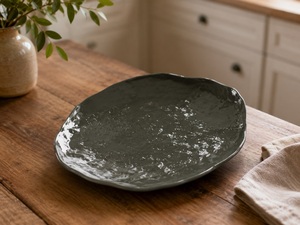
The iconic visual variance of rustic ceramics is engineered through Reactive Glazing. During the tunnel kiln firing cycle at 1280°C to 1320°C, metallic oxides such as iron oxide ($Fe_2O_3$), cobalt carbonate ($CoCO_3$), and copper oxide ($CuO$) undergo redox reactions. As the kiln gradually cools down over an 8-hour thermal curve, micro-crystals bloom within the molten glass layer, creating non-identical color gradients across every single plate.
China's top factories utilize computerized 60-meter continuous roller kilns, maintaining multi-zone temperature accuracy within $\pm 2^\circ\text{C}$. This eliminates physical warping while retaining rich visual unpredictability across mass production batches.
Material Performance Matrix: Stoneware vs. Earthenware vs. Porcelain
| Performance Metric | High-Fired Stoneware (China Top Standard) | Commercial Earthenware | Standard Hotel Porcelain |
|---|---|---|---|
| Firing Temperature | 1250°C – 1320°C | 950°C – 1080°C | 1300°C – 1400°C |
| Water Absorption Rate | < 0.5% (Vitreous) | 3.0% – 7.0% (Porous) | < 0.1% (Fully Vitrified) |
| Thermal Shock Resistance ($\Delta T$) | 180°C to 20°C (Pass) | 120°C to 20°C (Fails easily) | 160°C to 20°C |
| Edge Chipping Resistance | High (Reinforced Rim) | Low | Very High |
| Aesthetic Versatility | Ultra-High (Reactive, Tactile, Matte) | Medium (Decal prints) | Low (Mostly smooth white/monochrome) |
| Microwave & Dishwasher Safe | 100% Certified | Conditional / Risk of Crazing | 100% Certified |