Choosing the right B2B Ceramic Manufacturer can shape product quality, delivery stability, and long-term business performance. Global buyers often compare factories by more than catalog images. They examine material consistency, firing temperatures, glaze quality, production capacity, and export experience. A reliable supplier should explain these details clearly. They should also provide samples, technical specifications, packaging plans, and realistic lead times.
This guide introduces leading ceramic manufacturers serving international buyers across tableware, sanitaryware, tiles, decorative products, and industrial applications. It considers practical evidence, including factory capabilities, quality-control procedures, certifications, customization options, and communication standards. A strong manufacturer may offer automated molding, skilled hand-finishing, or both. The best choice depends on the buyer’s product requirements, target market, order volume, and budget.
Samples can reveal small but important differences. Check the rim smoothness, glaze coverage, color variation, and carton protection. Ask how defects are recorded and corrected. Also review payment terms, inspection arrangements, and after-sales support. Some manufacturers appear impressive online but provide limited technical information. That deserves careful attention.
No supplier is perfect.
A factory may have excellent craftsmanship but limited production capacity. Another may offer competitive pricing but slower communication. Buyers should verify claims through samples, factory audits, independent inspections, and documented references where available. This approach reduces avoidable risk without relying on marketing language alone. The following overview provides a practical starting point for comparing capable ceramic partners in the global B2B market.
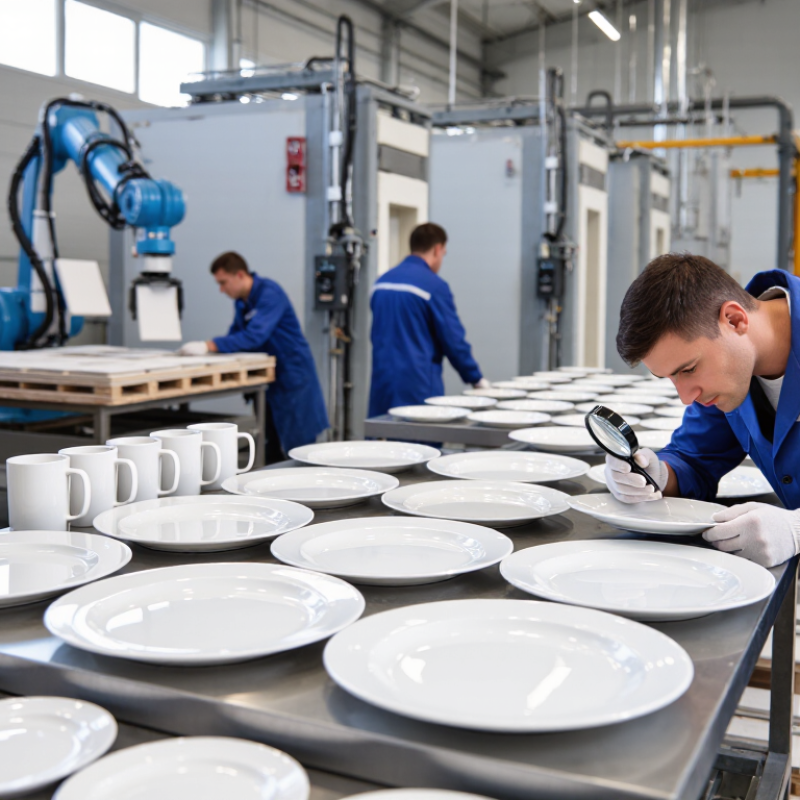
B2B ceramic manufacturers produce tableware, tiles, sanitaryware, technical parts, and other products for commercial buyers. Unlike retail suppliers, they manage repeat orders, specifications, packaging, and export documentation. Their global market role is practical and demanding. A reliable manufacturer must translate drawings, samples, and performance requirements into consistent production. Buyers should examine clay composition, firing temperature, glaze performance, and dimensional tolerance. Factory experience matters, but evidence matters more. Ask for test reports, production samples, and clear quality-control procedures. A glossy catalogue can still hide uneven edges or color differences between batches.
Tips: Request a small sample order first. Check carton strength, barcode accuracy, and surface finish after delivery. Confirm minimum order quantities, lead times, and replacement procedures in writing. Visit the production site when volume justifies the cost. It may reveal details that emails cannot.
Strong manufacturers support international buyers beyond the kiln. They understand pallet loading, moisture protection, inspection points, and destination-market labeling requirements. Experienced teams can suggest a safer wall thickness or a more stable glaze, but buyers should challenge every recommendation. Technical advice is useful only when supported by testing. Some factories claim flexibility, yet struggle with small design changes. That limitation is not always negative; focused production can improve consistency. Still, global purchasing requires honest communication about capacity, defects, and delays. The best partnership is rarely perfect. It is transparent, documented, and willing to improve after a failed sample or missed assumption.
Leading ceramic manufacturers now serve more than one niche. Their core categories include porcelain floor tiles, glazed wall tiles, sanitaryware, tableware, and technical ceramics. The Ceramic World Review 2024 reported global tile production at roughly 18 billion square metres in 2023. This scale explains the wide product range available to international buyers.
Porcelain tiles suit high-traffic floors, hotel lobbies, and outdoor areas. Wall tiles offer lighter formats and more decorative finishes. Sanitaryware includes toilets, basins, and bidets, with water efficiency becoming a stronger purchasing factor. Tableware focuses on durability, food safety, and consistent glazing. Technical ceramics support electrical, medical, and industrial applications where heat and wear resistance matter. Product names can sound similar, but test results often differ significantly.
Tips: Ask for water absorption, breaking strength, stain resistance, and slip ratings. Request recent laboratory reports, not only catalogue claims. ISO 13006 is commonly used for ceramic tile classification, while the International Energy Agency highlights efficiency as an important industrial priority. Check carton dimensions, pallet weight, shade variation, and replacement availability before ordering. A small sample may look perfect, yet a full container can reveal colour differences. That is an uncomfortable but common lesson. Also compare total landed cost, including packaging, inspection, freight, and local compliance. Industry reports provide useful benchmarks, but they cannot replace independent testing for a specific project.
A practical comparison of major ceramic product categories, materials, applications, and international purchasing considerations.
| Product Category | Common Ceramic Materials | Typical Product Formats | Main B2B Applications | Relevant Standards or Tests | Key Buyer Evaluation Points |
|---|---|---|---|---|---|
| Porcelain and Ceramic Tiles | Porcelain stoneware, red-body ceramic, white-body ceramic | Floor tiles, wall tiles, slabs, mosaics, trims, outdoor pavers | Commercial buildings, residential projects, hospitality, retail, public infrastructure | ISO 13006, EN 14411, ASTM C373, water absorption, breaking strength, slip resistance | Size consistency, water absorption, surface finish, shade variation, packaging, pallet stability |
| Sanitaryware | Vitreous china, fireclay, porcelain, ceramic glaze systems | Toilets, wash basins, bidets, urinals, cisterns, utility sinks | Residential construction, hotels, hospitals, offices, schools, transportation facilities | ASME A112.19.2, CSA B45.1, EN 997, EN 14688, flushing and leakage tests | Dimensional accuracy, glaze quality, flushing performance, water consumption, installation compatibility |
| Tableware and Hospitality Ceramics | Porcelain, bone china, stoneware, earthenware | Plates, bowls, cups, mugs, serving ware, hotel and restaurant sets | Hotels, restaurants, catering companies, institutional dining, foodservice distributors | Food-contact regulations, thermal shock testing, dishwasher resistance, microwave suitability | Chip resistance, glaze durability, stacking efficiency, lead and cadmium migration, replacement availability |
| Electrical and Electronic Ceramics | Alumina, steatite, porcelain, zirconia, cordierite | Insulators, substrates, terminal blocks, tubes, spacers, feedthroughs | Power distribution, electronics, automotive systems, telecommunications, industrial equipment | IEC 60672, IEC 60168, dielectric strength, insulation resistance, thermal cycling | Dielectric properties, dimensional tolerances, metallization, operating temperature, traceability |
| Technical and Advanced Ceramics | Alumina, zirconia, silicon carbide, silicon nitride, aluminum nitride | Wear parts, seals, bearings, nozzles, cutting components, precision substrates | Semiconductor equipment, aerospace, medical devices, chemical processing, mechanical engineering | ISO 14704, ISO 18754, fracture toughness, flexural strength, density, thermal conductivity | Material purity, microstructure, surface roughness, geometric tolerance, batch-to-batch consistency |
| Refractory Ceramics | Fireclay, high-alumina, mullite, magnesia, silicon carbide | Bricks, kiln furniture, crucibles, setters, castable components, furnace linings | Steel, cement, glass, foundries, ceramics production, non-ferrous metal processing | ASTM C20, ASTM C1161, refractoriness, permanent linear change, thermal shock resistance | Maximum service temperature, thermal cycling, chemical compatibility, load-bearing capacity, replacement cycle |
| Ceramic Bricks and Architectural Products | Fired clay, terracotta, extruded ceramic bodies | Facing bricks, roof tiles, ventilated facade elements, pavers, architectural screens | Building envelopes, residential developments, restoration, landscaping, urban design | EN 771-1, ASTM C62, ASTM C216, freeze-thaw, compressive strength, efflorescence tests | Color uniformity, weather resistance, dimensional tolerance, frost durability, installation system |
| Ceramic Filters and Membranes | Alumina, silicon carbide, cordierite, zirconia | Porous tubes, honeycomb filters, membrane supports, candle filters, catalyst substrates | Water treatment, air filtration, diesel exhaust treatment, chemical processing, industrial separation | Porosity, permeability, filtration efficiency, pressure-drop testing, chemical resistance | Pore-size distribution, flow rate, operating pressure, cleanability, service life, replacement cost |
| Ceramic Powders and Processing Materials | Alumina, zirconia, kaolin, feldspar, silica, talc, engineered composites | Spray-dried granules, milling powders, casting bodies, glaze frits, pigment systems | Tile production, sanitaryware, tableware, technical ceramics, additive and powder processing | Particle-size analysis, moisture content, chemical composition, loss on ignition, rheology testing | Particle distribution, purity, batch consistency, sintering behavior, storage conditions, technical documentation |
Quality begins on the factory floor, not in a sales brochure. Reliable ceramic manufacturers control clay moisture, particle size, forming pressure, drying time, and kiln temperature. A small firing variation can cause warping, pinholes, or shade differences. The European Commission’s Ceramic Manufacturing Industry BREF identifies firing as a major energy and emissions stage, often reaching 1,000–1,300°C. Buyers should request kiln profiles, inspection records, and batch-level traceability.
Compliance requires more than a certificate on a website. The ISO Survey 2022 recorded 1,265,216 ISO 9001 certificates worldwide, showing how common quality systems have become. Yet certification does not prove that every shipment meets specifications. Ask for recent test reports covering water absorption, bending strength, dimensional tolerance, chemical resistance, and lead or cadmium limits where relevant. Production audits should also review worker training, calibration records, corrective actions, and packaging tests. Some factories look excellent during audits. Their consistency over six months matters more.
Tips: Request a sample from a normal production batch. Compare it with the approved sample under natural and artificial light. Confirm the testing laboratory’s accreditation. Inspect the first shipment carefully; this is where assumptions become visible. A supplier may meet the standard but still miss your practical needs. That gap deserves attention.
Comparing global ceramic manufacturers requires more than checking catalog size. Ceramic World Review 2024 reported global tile production at roughly 16.7 billion square metres in 2023. This scale makes consistency difficult. A capable manufacturer should show calibrated kilns, stable glaze recipes, and documented batch testing. During factory evaluations, I look for sample panels under natural light. Small shade differences often appear there first. Production capacity alone proves little.
Reliability needs measurable evidence. Ask for on-time delivery records, defect rates, corrective-action reports, and backup raw-material plans. ISO Survey 2023 recorded millions of ISO 9001 certificates worldwide, but certification does not guarantee strong execution. It only shows that a quality system exists. Buyers should compare recent inspection reports with actual shipment records. The World Bank’s Logistics Performance Index 2023 also highlights customs, tracking, and delivery reliability as major supply-chain factors. These details matter when containers carry fragile, high-volume goods.
Request three production samples from different weeks. Test water absorption, dimensions, surface hardness, and packaging strength. Confirm inspection standards in writing. Leave room for doubt; supplier data may be selective, and laboratory results can differ from field performance. A factory that admits limitations may be more dependable than one promising perfection.
Ask for export records, average lead times, and delay-response procedures. Request recent inspection reports and shipment records. One polished catalog proves little.
No. Certification shows a quality system exists, but it does not guarantee stable output. Review batch records, glaze specifications, and breakage rates. Records can be selective.
Test water absorption, dimensions, surface hardness, glaze consistency, and packaging strength. Match testing with destination-market requirements. Independent laboratory results offer stronger evidence.
Visit physically or use a controlled video audit. Check kiln temperature records, calibration labels, pallet stability, and carton strength. Look for real production conditions.
One excellent sample may hide production variation. Request samples from at least three different weeks. Compare shade, dimensions, surface finish, and visible defects.
Request on-time delivery records, average lead times, and corrective-action reports. Ask how the supplier handles delayed containers. Fragile goods need practical contingency plans.
No. Capacity alone says little about consistency. Look for stable glaze recipes, calibrated kilns, batch testing, and backup raw-material plans. Scale can also create variation.
Trade data can reveal shipment patterns and declared market activity. However, classifications may be wrong or delayed. Use it with factory records, not alone.
Not automatically. A cheaper shipment with repeated breakage may cost more overall. Compare defect rates, packaging quality, delivery records, and payment terms. Price is not everything.
Strong suppliers answer specific questions clearly and explain limitations. Measure response speed and corrective-action quality. Perfect promises deserve caution. I would still leave room for doubt.
A B2B Ceramic Manufacturer plays a vital role in global trade by supplying ceramic products to distributors, retailers, construction companies, hospitality businesses, and industrial buyers. Leading manufacturers may offer a broad range of products, including tiles, sanitaryware, tableware, technical ceramics, decorative items, and custom-made components. Their value lies not only in product variety but also in their ability to support large orders, consistent specifications, private-label production, and international delivery requirements.
When evaluating suppliers, global buyers should compare manufacturing capacity, product quality, customization options, lead times, communication, packaging, and logistics support. Reliable ceramic manufacturers maintain clear quality-control procedures, use suitable raw materials, and follow recognized production, safety, environmental, and export standards. Buyers should also review sample consistency, inspection processes, certifications, production technology, and after-sales service. By comparing manufacturers according to capability, compliance, reliability, and long-term cooperation potential, international purchasers can select a supplier that balances quality, cost, flexibility, and dependable performance.