Choosing the best Stoneware Ovenware supplier takes more than comparing prices or browsing attractive product photos. The right partner must deliver cookware that looks consistent, performs reliably, and arrives ready for careful inspection. A dependable supplier should explain its clay body, firing process, glaze options, and quality checks in clear terms. Small differences matter. A rim that feels rough, a glaze with uneven coverage, or a lid that fits poorly can affect both presentation and everyday use.
Ask for product samples and examine them under ordinary kitchen conditions. Check the finish, weight, dimensions, and fit. Request details about temperature limits and testing methods, then confirm that the information applies to the exact product you plan to buy. Supplier statements are useful, but they are not a substitute for evidence. No checklist catches everything. A sample may look excellent while later production varies, so ask how batches are inspected and how defects are handled. That question is easy to overlook.
Also review minimum order quantities, production lead times, packaging, and communication practices. Strong packaging matters: stoneware needs protection from knocks during storage and shipping. If you sell across different markets, verify that the supplier can provide relevant product and material documentation for your requirements. Price still matters, but the lowest quote may leave little room for consistent finishing or careful packing. A practical choice balances workmanship, evidence, service, and cost. Some details will remain uncertain until a trial order arrives; acknowledge that, and use clear acceptance criteria before scaling up.
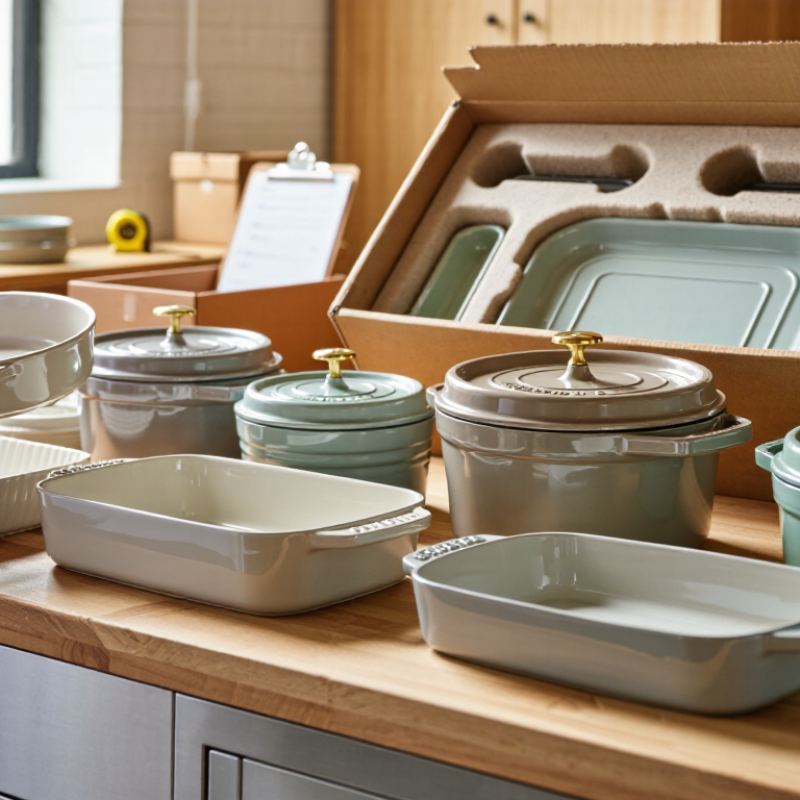
Before contacting a supplier, define how each piece will be used. A shallow roasting dish needs different dimensions and handling strength than a small ramekin. Record capacity, rim-to-rim measurements, usable cooking area, weight limits, and whether lids are required. Specify the oven temperature range and expected heating and cooling cycles. Be precise. A vague “oven-safe” claim leaves too much room for interpretation.
Set measurable quality criteria for samples and production batches. ASTM C373-18(2023) describes methods for measuring ceramic water absorption and related properties; ask suppliers to provide test results, not just verbal assurances. You might set a maximum absorption target, such as 3%, as your purchasing specification, while making clear it is your requirement—not a universal stoneware limit. For food-contact items, ISO 6486-1:2019 covers test methods for lead and cadmium release from ceramic articles. Request reports that identify the tested product and laboratory. Also define acceptable variation in glaze color, warping, chips, and dimensions. Real use can reveal flaws that a showroom sample misses. Test pieces in your own oven, including cold-start and repeated-use cycles, and keep notes on fit, staining, and handling. Even a careful specification may need revision after real-world trials.
When comparing stoneware ovenware suppliers, ask for the clay-body specification, firing temperature, and test records—not just a glossy sample. The USGS Mineral Commodity Summaries 2024 estimated U.S. common-clay production at about 24 million metric tons in 2023. That scale shows how widely clay is sourced; it does not prove a batch suits ovenware. Request details on clay consistency, glaze fit, and water absorption. A dense, evenly fired body should show no pinholes, rough foot rings, or visible warping.
Manufacturing controls matter just as much. Ask how the supplier manages kiln temperature, firing time, and cooling, then request results from thermal-shock and repeated-use tests. ASTM C424 describes a thermal-shock test method for glazed ceramic whitewares; it can help frame a supplier’s testing conversation, though it is not a guarantee of product performance. Inspect several pieces from different production runs. One attractive sample can hide variation. I would also check how defects are recorded and whether corrective actions are documented.
Tips: Request a written test report tied to the exact body and glaze. Ask whether the test used the finished ware, not a laboratory coupon. Compare results across batches, and clarify whether the supplier’s recommended oven-use conditions match your intended use. Small details matter—especially around handles, rims, and glaze thickness.
A stoneware supplier’s experience should show up in records, not just a long company history. Ask how many years the factory has produced ovenware, which clay bodies it regularly fires, and how it controls glaze and wall thickness. Request recent samples from normal production, not specially prepared pieces. Check batch inspection records and ask how the supplier handles warping, glaze defects, and failed pieces. Small details matter. A slight difference in rim thickness can affect how consistently pieces heat and stack.
Production capacity needs equally concrete evidence. Ask for monthly output by product type, kiln schedules, current utilization, typical lead times, and peak-season performance. The Deloitte and Manufacturing Institute’s 2024 study projected 3.8 million U.S. manufacturing jobs would be needed by 2033, with 1.9 million potentially unfilled. That is a broad U.S. workforce forecast, not a measure of stoneware capacity, but it underscores why staffing and backup plans deserve scrutiny. Request a recent production schedule and compare promised volume with actual shipments. Ask what happens when a kiln is down or a large order arrives. A factory may quote impressive numbers; I would still verify them against records. Production capacity is not always as clear as a sales sheet suggests.
When choosing a stoneware ovenware supplier, ask how it verifies food-contact safety and heat resistance. Request current test reports from a qualified independent laboratory, and check that the tested material matches the product you plan to buy. Standards vary by destination, so confirm which requirements apply to your market. A confident sales answer is useful, but documented evidence matters more.
Tips: Ask for batch traceability, firing records, and written quality-control procedures. Find out how often staff inspect glaze coverage, rim smoothness, dimensions, and visible cracks. Request samples from more than one production batch if possible. Small details matter.
A sample can look flawless and still tell you little about routine production. I would not treat one good piece as proof of consistent quality. Ask what happens when a batch fails inspection, and whether the supplier keeps corrective-action records. Also confirm the stated oven-temperature range and care instructions. Stoneware can vary in thickness and composition, so avoid assuming every item handles sudden temperature changes equally well. A clear, specific answer is a stronger sign of reliable control than a polished brochure.
| Evaluation Dimension | What to Verify | Recommended Acceptance Check | Weight |
|---|---|---|---|
| Food-contact safety | Test reports for lead and cadmium migration from the finished ceramic article, including its glaze and decoration. | Request reports for the exact product or a demonstrably equivalent construction. Confirm results meet the limits and test requirements in the destination market. Relevant references include ISO 6486 test methods and, for the EU, Directive 84/500/EEC as amended. Check applicable US FDA requirements for the intended use; FDA does not certify suppliers. | 20% |
| Laboratory credibility and report validity | Laboratory identity, accreditation scope, test method, sample description, report date, and results. | Prefer testing by a laboratory accredited to ISO/IEC 17025 for the relevant test. Verify that the report covers the product material, glaze, colors, and intended food-contact use being purchased. | 15% |
| Oven-use and thermal performance | Declared maximum use temperature, heating and cooling instructions, and performance test records for the finished ovenware. | Require a written temperature rating and clear use limitations. Confirm that testing reflects the intended use, including the product’s shape and thickness; do not assume stoneware is safe for broilers, stovetops, freezers, or sudden temperature changes unless specifically tested and rated. | 15% |
| Quality management system | Documented procedures for purchasing, production, inspection, nonconformities, corrective actions, and record retention. | Review the current quality-system certificate, if provided, and verify its scope and issuing body. ISO 9001 certification concerns a quality management system; it is not a product-safety certificate. | 10% |
| Incoming-material controls | Specifications and checks for clay bodies, glaze materials, pigments, and other production inputs. | Ask for material specifications, supplier approval records, and controls that prevent unapproved material substitutions. Confirm that changes affecting food-contact safety trigger reassessment or retesting. | 10% |
| In-process and final inspection | Inspection records for dimensions, warpage, cracks, glaze coverage, sharp edges, and other defects that affect use or safety. | Review the written inspection plan, sampling method, defect classifications, and acceptance limits. Agree on measurable criteria and inspection frequency before production begins. | 10% |
| Batch traceability and change control | Lot or batch identification linking finished goods to production records, materials, and inspection results. | Confirm the supplier can trace a finished batch through its records and explain how it controls changes to the clay body, glaze, decoration, manufacturing site, or process. | 10% |
| Packaging and transit protection | Packaging specifications and evidence that products are protected from impact and abrasion during handling and transport. | Review packaging samples and transit-test or shipment-damage records where available. Confirm that packaging prevents pieces from striking one another and protects rims and handles. | 5% |
| Corrective action and communication | Process for handling complaints, failed inspections, safety concerns, and product recalls or withdrawals. | Ask for a documented corrective-action workflow, named contacts, response timelines, and examples of how investigation findings are recorded and verified. | 5% |
How to use this table: Score each supplier against the evidence provided, then apply the weights for a comparative review. Confirm requirements for the destination market and intended use before placing an order.
When comparing stoneware ovenware suppliers, look beyond the unit price. Request a written breakdown covering tooling, packaging, sample fees, and shipping. Compare landed costs for the same order quantity and packaging standard. A low quote can still work, but only if quality checks and replacement terms are clear. Ask how the supplier handles chipped rims, uneven glazing, or damage found on arrival. Agree on response times and what evidence is needed for a claim.
Delivery deserves equal scrutiny. UNCTAD’s Review of Maritime Transport 2024 reports that more than 80% of world merchandise trade by volume moves by sea. For imported ovenware, port congestion and protective-packaging requirements can affect arrival dates. Ask for production, inspection, and dispatch milestones, not just an estimated delivery date. Confirm how the supplier packs heavy pieces; a sample carton can reveal weak dividers or excess movement. No forecast is perfect.
Tips: Request a recent quotation, a sample shipment plan, and the written after-sales procedure. Check who pays for replacements and whether spare units are available. Keep the answers together in one comparison sheet. Small details matter.
Suggested evaluation weights for comparing pricing, delivery, product quality, and after-sales support.
Use these suggested weights as a starting point, not as market statistics. Compare like-for-like quotations, confirm lead times and delivery terms, and check the warranty and process for handling damaged or defective goods.
Record each piece’s capacity, rim-to-rim size, usable cooking area, weight, and lid requirements. Specify oven temperatures and expected heating and cooling cycles. Be precise.
Define acceptable limits for water absorption, glaze color, warping, chips, and dimensions. A 3% absorption ceiling could be your purchasing requirement, not a universal stoneware limit. Put it in writing.
Ask for test reports that identify the specific product and laboratory. Include results for relevant food-contact testing, rather than relying on verbal assurances.
A showroom piece may not reveal flaws during everyday use. Try cold-start and repeated-use cycles, then note fit, staining, and handling. Real use tells you more.
Ask about ovenware production history, regularly fired clay bodies, and controls for glaze and wall thickness. Request recent samples from normal production, not specially prepared pieces. Records matter.
Request batch inspection records and details on how defects, warping, and failed pieces are handled. Small differences, such as rim thickness, can affect heating and stacking.
Ask for monthly output by product type, kiln schedules, current utilization, lead times, and peak-season performance. Compare a recent production schedule with actual shipments. I would double-check.
Ask what happens if a kiln goes down or a large order arrives. Request a backup plan and compare promised volumes with production records. Sales figures can be unclear.
Choosing the right Stoneware Ovenware supplier begins with a clear understanding of your product requirements, including intended use, dimensions, design, order volume, and customization needs. Compare suppliers’ material quality and manufacturing methods, paying attention to consistency, durability, finish, and their ability to meet your specifications. A supplier’s experience and production capacity can also indicate whether it can handle your current order and support future growth.
Before making a decision, review the supplier’s safety standards and quality-control procedures to understand how products are inspected and kept consistent. Then compare pricing alongside delivery schedules, communication, and after-sales support rather than focusing on cost alone. A reliable supplier should provide clear information, realistic timelines, and responsive assistance. Considering all these factors together can help you select a partner that delivers dependable Stoneware Ovenware and supports a smooth, long-term business relationship.