Sourcing Reactive Glaze Stoneware looks simple until the first sample arrives. The color may shift from blue-gray to amber under different light. Small pools, speckles, and flowing edges are expected. Yet uneven glaze, sharp rims, pinholes, or unstable food-contact surfaces are not acceptable surprises.
The global dinnerware market was valued at approximately USD 42.7 billion in 2021 and may reach USD 67.4 billion by 2031, according to Allied Market Research. This growth increases supplier choice, but it also creates more room for inconsistent specifications. Reactive glaze products are rarely measured as a separate market category. That gap matters. Buyers must verify factory data instead of trusting broad market claims. John Britt, author of The Complete Guide to High-Fire Glazes, emphasizes a practical rule: “Every glaze needs to be tested.” His point remains highly relevant when evaluating color variation, glaze fit, firing temperature, and leaching performance.
Details reveal quality. Check the foot ring for rough clay. Inspect the rim against a glass surface. Request fired samples from the same production batch. Ask for test records, clay-body composition, firing range, and food-contact documentation. A supplier’s polished catalog cannot replace physical inspection.
There is no perfect checklist.
Some variation gives Reactive Glaze Stoneware its character. Too much variation weakens a collection. This guide presents ten sourcing tips for balancing handmade appearance, production consistency, safety evidence, and commercial practicality. Mistakes can still happen. Better sourcing simply makes them less expensive and easier to detect.
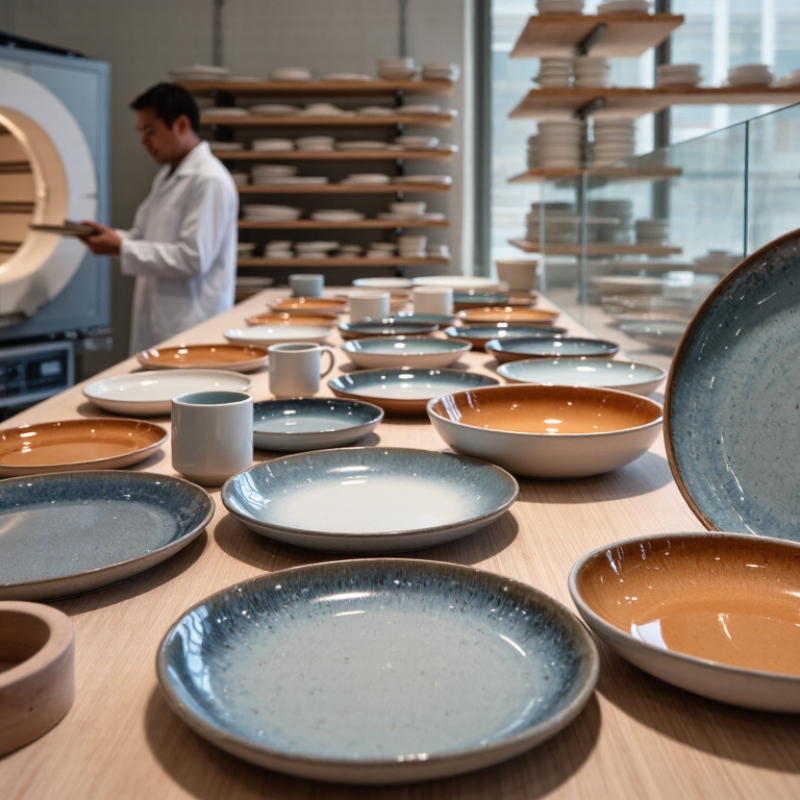
Reactive glaze stoneware is high-fired clay coated with a glaze designed to change during firing. Heat, mineral oxides, and kiln atmosphere create flowing colors, speckles, halos, and darker edges. No two pieces look completely identical. That variation is the central appeal.
Stoneware usually becomes dense and durable around 1200–1300°C, although firing ranges differ by clay body. A reliable supplier should explain the clay composition, glaze formula, firing temperature, and quality-control process. Ask for production samples, not only polished photographs. Touch the surface carefully. It should feel stable, without sharp pinholes, loose flakes, or rough foot rings.
I once approved a sample with beautiful blue pooling, then noticed uneven glaze near the rim. It looked minor, but repeated washing made the defect more obvious. That experience changed my inspection process. I now check ten or more pieces from one batch, compare color under daylight, and test stackability. Surface variation is expected; structural weakness is not. For tableware, request documented food-contact testing and clear care instructions. A reactive glaze may be attractive, but its performance still depends on the clay body, firing control, and final inspection. Suppliers sometimes describe natural variation too broadly. Ask what level of difference their factory considers acceptable.
Reliable sourcing begins with evidence, not attractive glaze photographs. Grand View Research estimated the global ceramic tableware market at approximately USD 10.7 billion in 2023, with continued growth expected through 2030. That expansion attracts capable factories and inexperienced intermediaries. Request the supplier’s legal company name, factory address, export history, and production photographs taken inside the workshop.
Evaluate production capability through measurable details. Ask for monthly stoneware output, kiln dimensions, firing temperatures, and documented quality-control procedures. A serious producer should explain its clay body, glaze formula control, firing curve, and cooling process. Reactive glazes can vary across shelves, so request samples from different kiln positions. Inspect foot rings, pinholes, crawling, warping, and glaze pooling under bright light. Small flaws matter.
The International Organization for Standardization’s ISO Survey reports millions of certified management-system certificates worldwide, but certification alone proves limited manufacturing skill. Verify the certificate scope and audit date. Ask for recent test reports covering food-contact safety, migration limits, thermal shock, and heavy metals. Requirements differ by destination, so the supplier must identify the applicable market standard. The U.S. Geological Survey’s Mineral Commodity Summaries also shows how ceramic raw materials depend on mineral supply conditions. Ask how the factory handles material substitutions.
A factory may offer perfect samples and inconsistent bulk goods. Require a pilot order. Record glaze codes, clay batches, firing schedules, and approved color tolerance. I would also inspect one shipment independently. My earlier assumption was that larger kilns always meant better control. They do not. Process discipline matters more.
Reactive glaze stoneware demands more than attractive photographs. Compare clay bodies by firing range, absorption, strength, and visual texture. A fine, pale body can sharpen glaze colors, while a darker body may create warmer, uneven edges. Ask for technical data and recent production samples.
Study glaze effects under real lighting. Look for pooling around carved lines, breaking on raised surfaces, and color movement near the rim. Request test tiles, not only catalog images. One sample can mislead. I once approved a deep blue glaze that appeared nearly gray under restaurant lighting. Small differences matter.
Measure sizes carefully, including diameter, height, weight, and stackability. Check whether each piece fits your shelves, packaging, and serving portions. Discuss customization options such as clay color, glaze density, carved patterns, foot-ring shape, and logo-free surface details. Confirm acceptable variation in writing. Handmade reactive finishes will not repeat perfectly, and that imperfection may be part of their value. Still, excessive pinholes, sharp edges, or unstable bases require rejection. Ask about sample approval, production tolerances, replacement terms, and food-contact testing. Reliable sourcing includes clear records, consistent communication, and a realistic lead time.
10 Tips for Sourcing Reactive Glaze Stoneware
Reactive glaze stoneware needs more than attractive photographs. Ask suppliers for fired samples from several production batches. Compare glaze movement, pinholes, crazing, warping, and color variation under natural light. Request test results for water absorption, thermal shock, lead, and cadmium migration. ISO 9001 certification can support process control, but it does not replace independent laboratory testing. The ISO Survey 2023 recorded more than 1.2 million ISO 9001 certificates worldwide, showing its broad use as a quality framework.
Packaging deserves equal attention. Inspect carton strength, edge protection, separators, and pallet stability through a drop-test plan. Take photographs before sealing each shipment. A single broken rim can damage an entire hospitality order. The 2023 World Bank Logistics Performance Index evaluates 139 economies, highlighting customs, infrastructure, shipment quality, and delivery reliability. Ask for measurable packaging results, not vague promises. I have found that “export packing” often means different things to different factories.
Shipping terms must be written precisely. Clarify the Incoterm version, loading port, insurance responsibility, documentation, and claims process. Sea freight carries roughly 80 percent of global merchandise trade by volume, according to UNCTAD’s Review of Maritime Transport 2023. That scale does not eliminate risk. Request carton counts, gross weights, container photos, and a pre-shipment inspection deadline. Also confirm whether replacement pieces or credit cover transit damage. One weakness remains: sample performance may not represent mass production. Keep a retained sample, record glaze codes, and approve the first production run before expanding the order.
10 Tips for Sourcing Reactive Glaze Stoneware
Calculate the landed cost before comparing supplier prices. Include clay, glaze, labor, packaging, freight, duties, inspection, breakage, and payment fees. Tip 1: Request a cost sheet with every line item. Tip 2: Price samples separately. Tip 3: Add a breakage allowance. My first costing sheet was too optimistic. A 3% defect rate can damage margins quickly. The World Bank’s 2023 Logistics Performance Index assessed 139 economies across customs, infrastructure, tracking, and delivery reliability. Use those factors when reviewing production locations. Tip 4: Compare suppliers by logistics performance, not factory price alone.
Reactive glazes vary with kiln temperature, clay moisture, and firing atmosphere. Tip 5: Approve a signed color panel under neutral lighting. Tip 6: Test at least three production batches. Tip 7: Measure dimensions after firing. This catches warping early. Ask for glaze thickness, firing curves, and quality records. A supplier should explain variation clearly, not hide behind attractive samples. Tip 8: Confirm packaging tests for stacking, vibration, and humidity. One damaged carton is useful evidence, not just bad luck.
Long-term sourcing needs working-capital discipline. Tip 9: Negotiate staged payments linked to inspection milestones. Protect cash flow. The UNCTAD Review of Maritime Transport 2024 reported 2.4% growth in seaborne trade during 2023, while disruptions continued affecting routes and freight planning. Tip 10: Maintain a backup supplier and review freight assumptions quarterly. Visit production when possible. Ask difficult questions. I would also score communication speed, corrective-action quality, and batch consistency. A low quote may still be expensive when delays and replacements accumulate.
| No. | Sourcing Tip | Key Dimension | Practical Benchmark | Verification Method | Cost or Risk Impact |
|---|---|---|---|---|---|
| 1 | Define the product specification first | Material and dimensions | Stoneware body; 1.5–4.0 mm wall thickness; dimensional tolerance typically within ±2–3 mm | Approved technical drawing, sample measurement and pre-production sample | Reduces tooling changes, quotation differences and production disputes |
| 2 | Evaluate reactive glaze consistency | Color and surface variation | Define an approved color panel with acceptable light, medium and dark variation zones | Compare mass-production samples under daylight and indoor lighting | Clear limits reduce rejected goods caused by the natural variation of reactive glazes |
| 3 | Check food-contact compliance | Lead and cadmium migration | Use an accredited laboratory and test the finished glazed article, not only the raw glaze | Request current test reports matching the exact glaze, body and production site | Prevents customs delays, recalls and market-access problems |
| 4 | Confirm thermal performance | Thermal shock and oven suitability | Specify the intended use: microwave, dishwasher, oven or freezer; do not assume all stoneware is oven-safe | Use a documented test protocol and retain test samples from each approved batch | Avoids cracking claims and reduces after-sales replacement costs |
| 5 | Compare total landed cost | Unit price versus delivered cost | Include product, packaging, freight, insurance, duty, inspection and local handling charges | Use the same shipping term, quantity, destination and currency for every quotation | A lower factory price may produce a higher delivered cost after logistics and defects |
| 6 | Review minimum order quantity | MOQ and color commitment | Typical custom ceramic MOQs range from about 500–3,000 pieces per design or glaze color | Confirm whether the MOQ applies per shape, per color, per size or per shipment | Prevents excess inventory and cash being tied up in slow-moving colors |
| 7 | Measure capacity and lead time | Production reliability | Sample development commonly takes 2–6 weeks; repeat production often takes 30–60 days, excluding transport | Request a monthly capacity plan, production calendar and shipment history | Reliable planning lowers stockout risk and emergency freight costs |
| 8 | Audit quality-control procedures | Defect prevention | Use written inspection criteria for glaze pinholes, crawling, cracks, warpage, stains and sharp edges | Conduct pre-production, during-production and pre-shipment inspections | A defined AQL plan helps control quality without relying on visual judgment alone |
| 9 | Assess packaging and breakage protection | Transport durability | Use dividers, cushioning and moisture-resistant export cartons; validate carton drop and vibration resistance | Perform a packed-carton test and record breakage by shipment | Better packaging can cost more per piece but lower replacement and claim rates |
| 10 | Build a long-term supplier scorecard | Weighted supplier selection | Score quality, compliance, cost, capacity, communication, flexibility and sustainability out of 100 | Re-score after every shipment and review quarterly | Encourages continuous improvement instead of selecting only by the lowest quotation |
| Cost Component | Benchmark Amount (USD) | Calculation Basis | Cost-Control Action |
|---|---|---|---|
| Reactive glaze stoneware item | 2.80 | Illustrative FOB-equivalent unit quotation for a medium-sized item | Compare like-for-like dimensions, glaze coverage and packaging |
| Individual and export packaging | 0.35 | Divider, protective material, inner box and export carton | Test packaging before increasing material thickness |
| Pre-shipment inspection | 0.08 | Inspection fee allocated across the order quantity | Use risk-based inspection frequency for stable repeat orders |
| Ocean freight and insurance | 0.62 | Estimated allocation based on packed volume and shipment size | Improve carton utilization and consolidate compatible orders |
| Duty, customs and local handling | 0.41 | Destination-specific estimate; actual rates depend on classification and market | Confirm tariff classification with a qualified customs broker |
| Estimated landed cost | 4.26 | Total before warehousing, financing, marketing and selling expenses | Use landed cost, not unit quotation, for supplier comparison |
| Evaluation Dimension | Weight | Minimum Acceptance Standard | Profile A | Profile B | Profile C |
|---|---|---|---|---|---|
| Product quality and glaze consistency | 25% | Approved sample maintained across production batches | 88 | 78 | 91 |
| Food-contact and product compliance | 20% | Current third-party reports for the exact finished product | 90 | 82 | 86 |
| Total landed cost competitiveness | 20% | Quotation includes comparable terms, packaging and logistics assumptions | 80 | 92 | 76 |
| Capacity and delivery reliability | 15% | Documented production plan and stable repeat-order lead time | 84 | 75 | 89 |
| Communication and corrective action | 10% | Written response within one business day and documented root-cause analysis | 86 | 80 | 84 |
| Weighted total score | 100% | Preferred long-term sourcing range: 80 points or above | 85.8 | 81.8 | 85.3 |
Cost figures and supplier scores are structured planning benchmarks. Final values should be confirmed using destination-specific freight, duty, testing, packaging and inspection quotations.
Request the legal company name, factory address, export history, and recent workshop photographs. A supplier with evidence is safer. Ask for monthly output, kiln size, firing temperature, and quality-control records.
Ask about the clay body, glaze control, firing curve, cooling process, and material substitutions. Request samples from different kiln positions. Reactive glazes may vary across shelves.
Inspect foot rings, pinholes, crawling, warping, glaze pooling, sharp edges, and unstable bases. Use bright light and rotate each piece slowly. Small flaws matter.
Compare firing range, absorption, strength, texture, color, and surface movement. Request test tiles and recent production samples, not catalog photographs alone. Lighting can mislead.
Record diameter, height, weight, stackability, and serving capacity after firing. Check every piece against your shelves and packaging. Measure twice.
Approve a signed color panel under neutral lighting. Test samples from at least three production batches. Record acceptable variation in writing, because handmade finishes will not repeat perfectly.
Request recent food-contact, migration, thermal-shock, and heavy-metal test reports. Verify the certificate scope and audit date. Requirements differ by destination.
Include clay, glaze, labor, packaging, freight, duties, inspection, breakage, and payment fees. Add a realistic defect allowance. My first estimate was too optimistic.
Use staged payments linked to inspection milestones. Test packaging for stacking, vibration, and humidity. Keep a backup supplier and review freight assumptions regularly. Cheap is not always cheaper.
Sourcing Reactive Glaze Stoneware successfully requires a clear understanding of its defining features, including layered color variation, organic surface movement, durability, and the unique character created during firing. Start by identifying reliable suppliers with consistent production capabilities, suitable kiln capacity, experienced quality teams, and transparent communication. When comparing options, review the clay body, glaze effects, available sizes, shapes, finishes, and customization possibilities to ensure the products match your design and functional requirements.
Before placing a large order, request samples and examine their color consistency, surface finish, strength, dimensions, and resistance to daily use. Confirm quality standards, inspection procedures, packaging methods, lead times, minimum order quantities, and shipping terms. Finally, calculate the complete cost, including production, customization, packaging, transportation, and potential replacement expenses. Selecting a supplier should depend not only on the lowest quotation but also on stable quality, dependable delivery, flexible service, and the ability to support long-term sourcing needs.